Saturday, August 30, 2014

The journey of Sky, Amber and Scout: Disney Nature's "Bears".

After "Earth", Disney amazes again with an extraordinary documentary about the life of an Alaskan bears family and their incredible habitat. 
The journey of this mama-bear and her two cubs starts at the end of winter in the mountains, going down to the coast looking for food, facing the thousands of troubles and threats of the wild life. 
This documentary also shows the life of the other Alaskan bears and of other species surrounding them like wolves, American eagles, salmons ecc. 
I strongly recommend to watch it to all the people who (like me) are spellbound in front of the uncontaminated nature and the magical shows that it can give. 


Friday, August 29, 2014

INDONESIA: deforestation champion.

The magazine "Nature climate change" published a report about deforestation which revealed that Indonesia has a double deforestation rate compared to the Brazilian one and so it has become the greatest forests destroyer in the world : 840.000 hectares (compared to 460.000 hectares destroyed by Brazil) of primary and uncontaminated forests.
But there are good news... The winner of the latest political elections, Joko Widodo, has announced a plan to preserve the forests. We hope they won't remain just words...

Wednesday, August 27, 2014

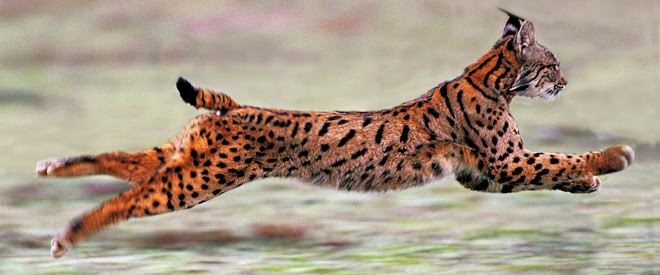
The Iberian lynx.

Lynx pardinus is a species native to the Iberian Peninsula which is in a serious danger of extinction. It is the most threatened feline in the world. 
According to the organization SOS Lynx if it went extinct it would be the first extinction after the one of Smilodon 10000 years ago (indeed it is not a subspecies of the European lynx but a species in its own right).

It is 85-110 cm long and 60-70 cm tall and weighs about 13 kilos. It eats rodents, birds, amphibians and small reptiles; its biggest prey is the hare. It lives in territories of approximatley 10-20 square kilometres. 
Up to the half of the 19th century it was present in almost all the Iberian Peninsula. Nowadays there are only two small zones left in Andalusia, in southern Spain. In 2005 less than 100 specimens were counted, while in 2000 they were more or less 400 and in 1960 they were 4000. 

The only zones in which they live now are DoƱana National Park and Andujar Sierra. 
The reasons for the disapperance of the Iberian lynx are the destruction of its habitat, voluntary or accidental poisonings, car accidents, wild dogs, poaching and the lack of preys. 

Luckily, there are good news. In 2005, precisely on the 29th of March, there was the first birth in captivity. In the two zones populated by the lynx, great efforts have been made and this species is on the road to recovery. In 2008 in the Andujar zone the maximum capacity was reached (150 speecimens). 
Now it is estimated that from here each year approximately 20 specimens are taken to be reintroduced in other zones. 


(Thanks to Lorenzo S. for helping me writing this post) 

Tuesday, August 26, 2014

Floating nuclear power plants in the Arctic...Imminent catastrophe.

In Pevek, a small Siberian town bathed by one of the earth's coldest seas, the Russians are completing the first prototype of floating nuclear power plant. 
This power plant is composed of 2 mini reactors of 35 megawatts, mounted on a platform which can be transported offshore. Indeed, the designers created this all to be able to transport it in the remotest regions of the Arctic Ocean. 
As if this were not enough, this power plant is going to be used to give energy to the drills of the Arctic oil platforms. The manifacturer said that other floating nuclear power plants of 1000 megawatts to be moored off the cost of Siberia are in planning, to produce energy that, through submarine cables, will be brought to the mainland. 


The power plants are using the Arctic marine water for the cooling. 
If something went wrong (which is very likely) an intervention in those seas would be almost impossible, while the destruction of the extremely fragile Arctic environment would be granted...and an enormous, shocking tragedy would be about to fall upon us all. 


(Thanks to Lorenzo S. for helping me writing this post)


Friday, August 1, 2014

82 years ago...the extinction of the Schomburgk's deer.

The Schomburgk's deer was anhelpc species which lived in Thailand. It lived in herds composed of 6-10 specimens in the low-lying and marshy areas of south-eastern Asia.
Its main characteristic were the long, tapered paws, totally different from every other American, European and Asian deer. Those paws were perfect to move in the unstable marshes in which it usually grazed the newly grown grass and shrubs.

Unfortunately, this beautiful animal was a victim of the industrial and demographic growth of its country: the rapid rise of rice request to feed an always greater population led to a total and indiscriminate reclamation of wetlands to be converted into rice fields.

As if that was not enough, the hunting of this animal exploded, to give meat to the workers who we're destroying its habitat.
The last Schomburgk's deer was probably killed on the 1st of August of 1932.

(Thanks to Lorenzo S. for helping me writing this post) 

Thursday, July 31, 2014

The return of the lynx in Italy.

1920 was the year of the official announcement of the extinction of the lynx in the Italian territory.
Unfortunately, during the same period in almost the whole Europe this beautiful feline was definitively disappearing, because of centuries of deforestation, reduction in the number of preys and direct persecution.

Between 1970 and 1986, 7 reintroduction programs were attempted in Italy, France, Switzerland and Germany. While in the other countries they had success, in Italy the results started to arrive late and only in 1971, after Switzerland had released about 30 lynx, there were the first reports of sightings in the western Alps, precisely in Aosta Valley and Ossola Valley.

From the 80s on the lynx (lynx lynx) has come back in the forests of northern Piedmont, Giulie Alps and Carniche Alps and is now going south, along the forests of the Apennines.

Today, the largest Italian population is in the Gran San Bernardo zone and the data collected by the forest rangers show that these wonderful animals have arrived to the Abruzzo National Park (with 2-3 confirmed pairs).
In spite of all, in Italy the lynx remains very vulnerable because of car accidents, poaching and the destruction of its habitat and of the ecological network in the Alpine valleys, which are too often crossed by highways or railways.

(Thanks to Lorenzo S. for helping me writing this post)

Sunday, July 27, 2014

JELLYFISH: a possible solution.

A research of an Italian university showed that the excess of jellyfish in the Mediterranean Sea causes each year high costs for the health service, as well as for some industries and for fishing.

So...this university made a proposal: why don't we eat them?
In China and other countries they're already doing it and jellyfish are considered a prized food. Actually, they have a low caloric content and they are rich of proteins, Omega 3 and Omega 6.

Today the turnover linked to the consumption of jellyfish is higher than 25 million euros. But there's a problem...the EU recognizes as edible only the Asian jellyfish and not the European ones.

The aim of this Italian university is to study in deep the nutritional properties of the European jellyfish, and also to investigate their possible use in the zootechnique and in the pharmaceutical research.