Sunday, January 11, 2015
Russia-Iran: the "animal diplomacy" doesn't stop.
The Russian vice Minister of Natural Resources and Environment, Igor Maidanov, during a visit to Iran signed a document which "is regulating the cooperation between the two countries to preserve the biodiversity and to develop the protected natural territories. The parties have signed the agreement during a meeting in Teheran (on the 29th of December of 2009) between the Russian vice Minister of the Resources, Igor Maidanov, and the Deputy Director of the Iranian Organization for the environment, G. B. Saduk".
This document disciplines the cooperation between the two countries "in the field of biodiversity conservation, development of particularly protected natural zones and Convention of Teheran". Iranians and Russians also examined the practical aspects of the programme of reintroduction of the Persian leopard (Panthera pardus saxicolor) in the Western Caucasus.
The programme, which started during September of 2009, aims to restore the population of these extremely rare felines, which are at risk of extinction, in the Russian part of the Caucasus, restoring the presence of the leopards in their ancient areal.
In September Maidanov asked the Iranian Ambassador in Moscow, Mamud Reza Sajjadi, if Iran could give some Persian leopards to reintroduce them in the Caucasus. This request concerns at least two female specimens so that they mate with the two males which were given to Russia from Turkmenistan and that are housed in a reserve near Sochi.
The leopard project was wanted directly from Vladimir Putin as a demonstration of environmental commitment on the occasion of the Winter Olympic Games in Sochi. Putin, who has a penchant for large carnivores, went to the city on the shores of the Black Sea to personally welcome the Turkmenain leopards.
Iran is one of the last shelters of Persian leopards, which once populated all the forests and mountains of the Caucasus and central Asia, Small populations of these leopards resist also in Armenia, Georgia and Turkmenistan.
Friday, November 14, 2014
Tiger: the largest cat.
Because of hunting and persecutions its population has decreased very rapidly: in 1930, in Asia, there were 100.000 tigers, in 1940 (only 10 years after) they were 40.000 and in 1970 their number was only 5.000 and 2 years later they were less than 2.000.
The measures against the poachers and the establishment of protected parks has led, since 1979, to a gradual recovery of the tigers, that today have reached approximately 6.400 specimens.
However, it was calculated that today there are more tigers in zoos and circuses than in nature.
The habitat of the tigers varies depending on the subspecies, from the Syberian coniferous forests to the mangrove swamps of Sundarban, to the arid scrublands in northwest India.
The surviving species of tiger today are: the Bengal tiger (4.500 specimens), the Syberian tiger (450 specimens), the Chinese tiger (30-80 specimens), the tiger of Sumatra (400-600 specimens) and the Indochinese tiger (1.000-1.750 specimens).
The Javan tiger has been driven to extinction (in the first years of the 19th century). The same thing happened to the Bali tiger (extinct in the 40s) and to the Caspian tiger (extinct in the 70s).
The tiger meat is used in Malaysia as a remedy against the irritations to the spleen and stomach while, in other Asian areas, it is believed that eating some parts of the tiger gives courage and heals some diseases. In Taiwan there's a kind of "wine" produced with tiger bones.
(Thanks to Lorenzo S. for helping me writing this post)
Monday, October 20, 2014
Why we should all be VEGETARIANS.
Italy has the highest rate of vegetarians in the EU: 10% of the population, 6 million people.
In Germany the rate is 9%, 10% in Sweden, 4.5% in the Netherlands.
In my opinion, we shoud all be vegetarians because of many reasons:
- I think it's cruel and inhuman killing other animals to eat them, basically just on a whim and, furthermore, the way of killing the animals in the slaughterhouses is horrible.
- There are environmental reasons: over 15.000 liters of water are needed to produce a kilogramme of red meat and we all know that water is becoming more precious day by day; one third of the world's crops are used to feed the farm animals and, obviously, meat has a lower yield in terms of quantity compared to the vegetables. And we complain about World Hunger...
- There are also health reasons: it is shown that meat contains substances which are harmful and eating them increases the risk of suffering from health problems, diseases and tumors.
What do you think about vegetarianism? Please, let me know by sending me an email to thenorthernlightsdiary@gmail.com!
Monday, October 6, 2014
The snow leopard: let's not lose it.
Its usual preys are wild sheeps and goats, but as the preys are scarce in the Asian mountains, it also eats deers, young yaks, wild donkeys and wild cattle.
Today, it is estimated that the snow leopard population is of 4080-6590 specimens.
The snow leopard is considered and endangered species by WWF.
In the past, it was heavily hunted for its fur but today it is threatened mainly because of the disappearance of its habitat, as it's being "conquered" by the herders with their flocks. They are often killed by the drovers because, as the food is scarce, it happens that they attack the flocks.
Furthermore, they are also killed because their bones are used in the Traditional Chinese Medicine instead of the tigers' ones.
WWF and other organizations, like International Snow Leopard Trust (ISLT) and Traffic (the international network which deals with the monitoring of wild fauna and flora) are launching an appeal to the countries where the snow leopard is present to get and immediate improvement in the controls and in the management efforts of the species to end the threat that hangs over it.
You can...
...help these organizations and publicize this situation with as many people as possible, creating an increasing media pressure.
What do you think about this? Write me to thenorthernlightsdiary@gmail.com!
Sunday, September 21, 2014
Another horror China branded.
Now to be different the trend is to organize dinners where a tiger is killed in front of a small group of people and then is torn to pieces and cooked. Some of them doesn't even wait the tiger to be cooked and drink its blood or eat its penis (thinking they have "magical" properties).
The South China tiger is considered probably extinct. The Sumatra tiger is close to extinction and other tigers like the Siberian, the Indian, the Malaysian and the Indo-Chinese are at serious risk of extinction.
The insane habits of these new rich are further endangering this beautiful animal species.
The Chinese government made this illegal, but notwithstanding this, it keeps happening.
The person who ate the (probably) last specimen of South China tiger is staying twelve years in prison; the one who ate three tigers in 2013 is spending decades in prison.
It's not the first time that Asian "magical" traditions seriously endanger species that are already threatened or at risk of extinction (rhinos, moonbears, elephants).
When will they stop...?
Sunday, September 14, 2014
Things we lost...The Atitlán grebe.
It became extinct because of the introduction in the homonyous lake of the smallmouth bass (native of North America) for sport fishing. This fish killed the nestlings and large quantities of grabs and fish which were the main food source of the grebe.
In 1983 there were only 32 specimens left and in 1989 the last two were sighted. After their disappearance this species was officially declared extinct.
(Thanks to Lorenzo S. for helping me writing this post)
Thursday, September 11, 2014
DANIZA: another bear sacrificed in the name of ignorance.
She died because of the anesthesia that has been given to her during the attempt of capture by the authorities of the province of Trento (Italy).
Her death is causing great controversy and outrage.
On the 15th of August she attacked a mushrooms seeker (who reported minor injuries) who went too close to her two cubs.
Since then, she had been monitored and had been seriously considered the opportunity of capturing her (in a first time, even of killing her).
The national institutions showed their incompetence in this situation.
But, who was Daniza?
She was 19 years old and was part of a bears reintroduction program in the Italian Alps, whose only crime was trying to defend her cubs, as every mother would do.
WWF and other animal welfare groups are now asking for explanations. Capturing her was not necessary, she wasn't a dangerous specimen.
Now we wonder what will happen to her two cubs, at the gates of winter. It is hoped that, at least, the authorities will be able to take care of them and ensure that they survive.
Thursday, September 4, 2014
Japan, stop killing Bluefin tuna!
In Japan the Bluefin tuna is particularly prized (a single large fish can fetch more than $ 100.000).
The large demand in this country led to aggressive fishing practices and the populations today are a tenth of what they were in the 1950s.
The decline is faster everyday because of open-ocean pens where wild juvenile tuna are put: these animals are removed from the wild before they have spawned and this is deleterious for the survival of the species.
http://www.worldwildlife.org/species/bluefin-tuna
Wednesday, August 27, 2014
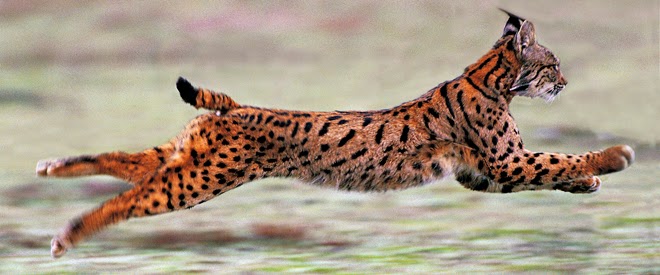
The Iberian lynx.
According to the organization SOS Lynx if it went extinct it would be the first extinction after the one of Smilodon 10000 years ago (indeed it is not a subspecies of the European lynx but a species in its own right).
It is 85-110 cm long and 60-70 cm tall and weighs about 13 kilos. It eats rodents, birds, amphibians and small reptiles; its biggest prey is the hare. It lives in territories of approximatley 10-20 square kilometres.
Up to the half of the 19th century it was present in almost all the Iberian Peninsula. Nowadays there are only two small zones left in Andalusia, in southern Spain. In 2005 less than 100 specimens were counted, while in 2000 they were more or less 400 and in 1960 they were 4000.
The only zones in which they live now are Doñana National Park and Andujar Sierra.
The reasons for the disapperance of the Iberian lynx are the destruction of its habitat, voluntary or accidental poisonings, car accidents, wild dogs, poaching and the lack of preys.
Luckily, there are good news. In 2005, precisely on the 29th of March, there was the first birth in captivity. In the two zones populated by the lynx, great efforts have been made and this species is on the road to recovery. In 2008 in the Andujar zone the maximum capacity was reached (150 speecimens).
Now it is estimated that from here each year approximately 20 specimens are taken to be reintroduced in other zones.
(Thanks to Lorenzo S. for helping me writing this post)
Friday, August 1, 2014
82 years ago...the extinction of the Schomburgk's deer.
The Schomburgk's deer was anhelpc species which lived in Thailand. It lived in herds composed of 6-10 specimens in the low-lying and marshy areas of south-eastern Asia.
Its main characteristic were the long, tapered paws, totally different from every other American, European and Asian deer. Those paws were perfect to move in the unstable marshes in which it usually grazed the newly grown grass and shrubs.
Unfortunately, this beautiful animal was a victim of the industrial and demographic growth of its country: the rapid rise of rice request to feed an always greater population led to a total and indiscriminate reclamation of wetlands to be converted into rice fields.
As if that was not enough, the hunting of this animal exploded, to give meat to the workers who we're destroying its habitat.
The last Schomburgk's deer was probably killed on the 1st of August of 1932.
Thursday, July 24, 2014
FISH AT RISK. Be part of the change.
Some species which are at particular risk are the anglerfish (or monkfish or goosefish), the Patagonian toothfish (or Chilean seabass), the sharks, the skates and rays. There are lots of other species in danger and you can find them by clicking on this link http://www.greenpeace.org/international/en/campaigns/oceans/seafood/red-list-of-species/.
We all can do something to help the situation change, for example by buying fish from retailers and restaurants that have made a clear public commitment to sourcing and selling better fish.
We all can be part of the change.
Monday, July 14, 2014
The Marsican Brown Bear.
This subspecies of brown bear weighs almost 100-150 kilos and when in upright position it reaches a height of nearly 1,80 meters.
During the centuries it was ruthlessly hunted because there was the belief that it preyed the cattle grazing. Instead, this solitary and shy plantigrade has strictly nocturnal habits and a vegetarian diet for more than 90% (berries, roots, fruits, tubers) and only occasionally it eats small mammals, birds, reptiles and amphibians.
Sometimes it eats carcasses of large herbivores that it finds in its territory (which is usually from 10 to 200 square kilometers, depending on the food available).
Today, the poisonings, the traps and the hunt are severely forbidden but this bear is practically relegated only in the Abruzzo National Park with a population of about 40 specimens (in 1969 they were approximately 60).
This is another proof of how the mankind adversely affects the environment that surrounds him, often without showing a modicum of respect to all the creatures with which he shares this world.
(Thanks to Lorenzo S. for helping me writing this post)
Sunday, July 13, 2014
South Africa VS Melissa Bachman
After every killing she posts on Facebook and Twitter photos (like the one you can see below) with a radiant smile and sentences like "beautiful day in Africa".
In the US her social contacts have been rapidly swamped by an avalanche of insults and threats and in South Africa a petition has started (which has already reached 12 thousand signatures) to prevent Bachman from entering the African country.
"She is in total contradiction with the South African conservation culture, of which this country is proud", explains Elan Burman, who promoted the petition.
(Thanks to Lorenzo S. for helping me writing this post)
Wednesday, July 2, 2014
The White-rumped vulture is in danger!
Wednesday, June 18, 2014
Finally salvation and justice for seals!
Canada and Norway LOST their appeal against the embargo imposed by the EU countries on the import of seal derivatives!
The two countries had tried to appeal against the decision of the World Trade Organization (WTO), which during the last Novermber had confirmed the validity of the European embargo.
The world public opinion is no longer willing to endure the despicable massacres on the Canadian ice and this is proven by the fact that, after the EU, also other countries decided to put an embargo on those products. These states are Taiwan, Russia (which alone took almost 90% of the slaughtered Canadian seals) and China, shattering Canadian hopes to dampen the western loss of revenue selling in the Chinese emerging market.
(Thanks to Lorenzo S. for helping me writing this post)
Friday, June 13, 2014
Swedish Big 5: the Golden Eagle.
The Golden Eagle is the second largest bird of prey in Sweden. They are shy and prefer to live in unpopulated areas, although sometimes they may come closer to inhabited areas to take advantage of carrion found on roads or in gardens.
Thursday, June 12, 2014
WWF: save the African rhinos.
Once upon a time, in Africa's savannahs...there were over a million black and white rhinos. After the Europeans' arrival, the rhino numbers and distribution quickly declined. An escalation in poaching happened between the 1970s and the 1980s, as a result of a high demand for rhino horn, used in traditional Asian medicines and valued for dagger handles in the Middle East.
Today, thanks to conservation and anti-poaching efforts, some African rhino populations are stable or increasing, though poaching still occurs. Anyway, it is hard to find African rhinos outside of protected areas and sanctuaries.
WWF is at the forefront of conservation of African rhinos. In 1997 they adopted a strategic and proactive approach to rhino conservation: the African Rhino Programme (ARP). This programme works in cooperation with many partners (government bodies, other conservation groups and NGOs, the private sector and local communities).
Thank to WWF's anti-poaching projects rhinos are now recovering. When the ARP launched there were 8,466 white rhinos and 2,599 black rhinos in the wild: nowadays there are over 20,000 white rhinos and almost 5,000 black rhinos.
However, there's still more to do. Expanding existing protected areas and establishing new ones, improving security monitoring against poaching and improving local and international law in this field, promoting well managed wildlife-based tourism experiences to provide additional funding for conservation efforts.
To help WWF...
Don't buy rhino horn products, donate towards much-needed anti-poaching equipment and support for rangers across Africa and spread the word sharing this information with others!
For more information http://wwf.panda.org/what_we_do/endangered_species/rhinoceros/african_rhinos/
Wednesday, June 11, 2014
Corrida? No, gracias!
She argues that the famous "corrida" (bullfight) represents the very essence of being Spanish.
<< Being against bullfighting is equivalent to being anti-Spanish...>>.
In Aguirre's opinion, bulls perfectly represent the Hispanic character and spirit.
Unfortunately for her, recent polls show that 72% of her compatriots do not appreciate this traditional "show", with peaks of 82% amongst the young people and of 79% among the women.
So, in the words of Aguirre in the whole Spain there would be a little less than 13 millions of "genuine Spanish" left...
Just to give you an idea of what "corrida" is...
Before the bull enters the arena he is kept in the dark, subjected to drugs and purges; he is beaten on the back with bags of sand; the turpentine is sprinkled on his paws, so that he cannot stand still; Vaseline is put in his eyes to cloud his view; his nostrils and throat are blocked; needles are pushed in his body.
When the bull enters the arena "picas" are pushed into his body and they cause pain and hemorragies; "banderillas" (harpoons) are inserted in the bull's body: they lacerate even more his muscles, forcing him to lower the head; he is struck repeatedly by the sword causing increasingly severe pulmonary haemorrhage which suffocate the animal.
When the bull comes out of the arena he is dragged away, often still dying and paralyzed, but conscious; when he is still alive, his ears and tail are cut, as trophies.
At the end, he is slaughtered.
CAN THIS HORROR BE CONSIDERED THE SYMBOL OF A NATION?